Guides
How Tax Preparers Review Sales Tax Filing Deadlines Each Year
Sales tax filing deadlines for preparers drift out of sight when the state list is stale. Build two lists, compare them, and fix the calendar gaps early.
What to take away
- Every open sales tax registration carries a filing deadline, and a nil return has one too. Your registration list is your deadline list.
- Dormant accounts keep their deadlines until the state closes them in writing.
- A missing registration is a missed deadline waiting to be counted, and the exposure grows period by period.
- PTIN renewal and e-file closures belong on the same calendar as the state frequencies.
Where a sales tax filing deadline comes from
Registrations set your state due dates, not the federal calendar, which is why sales tax rules are written state by state, never nationally. Each state where you hold an open account sets its own frequency and its own due date.
The IRS page on state tax deadlines that differ from federal shows how wide that spread runs. A practice filing in eleven states is running eleven calendars.
The misses I see are rarely arithmetic. They are calendar errors: a state added in June, a frequency changed in January, a period nobody owned.
Read the rule where each state writes it
Sales tax is a state tax, so the return, the frequency and the due date all come from the state, not from a federal table. Four states that sit on most practices' lists show how the pieces fit:
- Californiathe California Department of Tax and Fee Administration (CDTFA) assigns the filing frequency and publishes the state's sales and use tax return, filed through its online services.
- Texasthe Texas Comptroller of Public Accounts uses Form 01-114, due the 20th of the month after the reporting period, filed through Webfile.
- New Yorkthe New York State Department of Taxation and Finance uses Form ST-100 for quarterly sales and use tax filers, due 20 days after the quarter ends, filed through Sales Tax Web File.
- Floridathe Florida Department of Revenue uses Form DR-15, due the 1st of the month after the period, with the tax treated as late after the 20th, filed through eServices.
Registration runs through the same office: the permit or account number comes first, and the return form and frequency follow it. Frequencies are monthly, quarterly or annual, set by the state from the tax you collect and reset when your volume changes. Nil returns are still returns, and most states expect one for every period the account stays open. Extensions are rare in sales tax: most states do not extend the return date at all, and where an extension exists it usually applies only to annual filers.
Build the state list from documents
Write the list by state, from records you can open: registrations, prior returns, payroll accounts, warehouse leases and remote hires. Start with the registrations you already hold, then work outward.
Six record categories usually cover it: state registrations, prior returns, payroll accounts, warehouse leases, remote hires and marketplace facilitator reports. Getting the list right matters more than getting it quickly, because everything downstream is built on it.
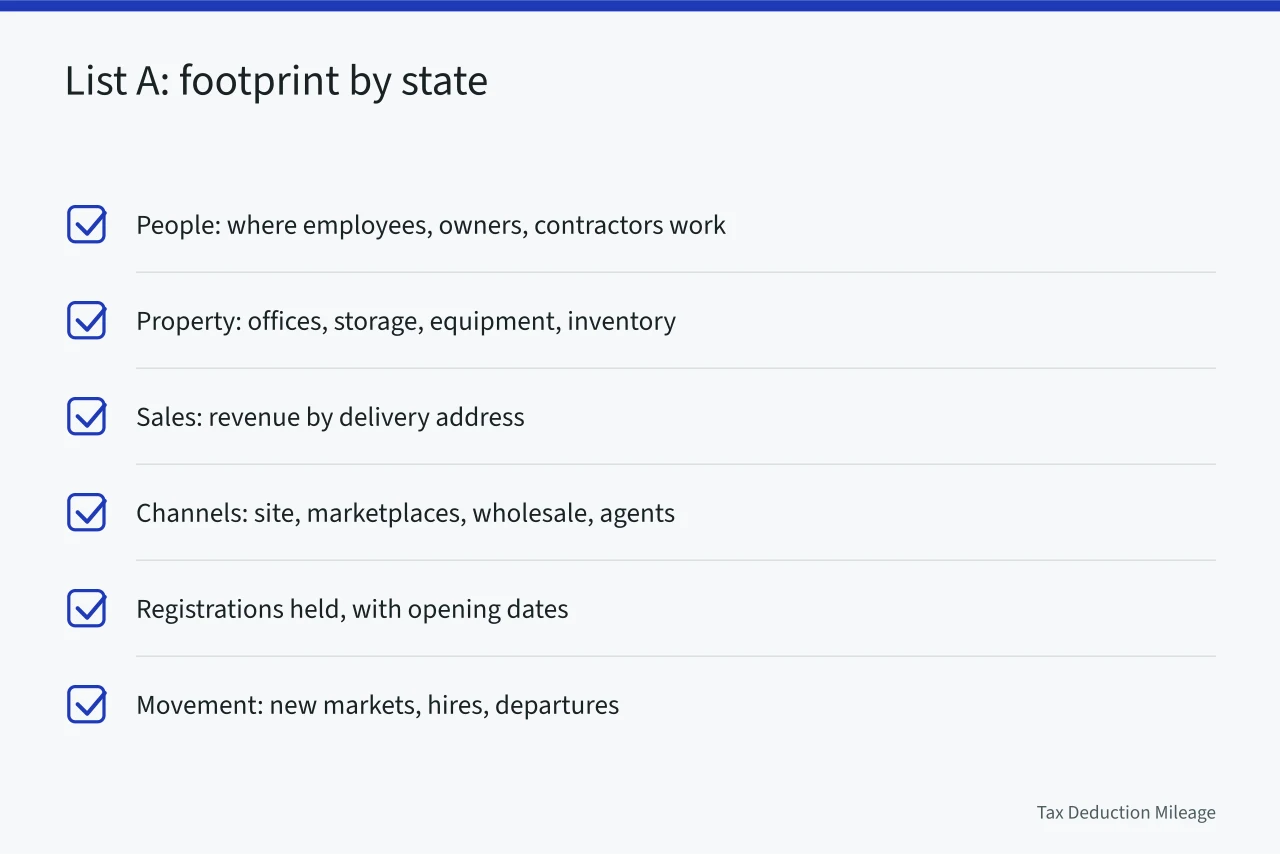
The gathering is the slow part, and working through the sales tax checklist in order keeps it from drifting into guesswork.
If the list cannot be built from documents, that is finding number one, and it is worth fixing before any calendar work starts.
Build the filing table from the registrations
One row per state, and one column more than most practices keep.
| State | Frequency | Next due date | Extension rule | Nil returns | Owner |
|---|---|---|---|---|---|
| One row per open account | Monthly, quarterly or annual | From the state's own notice | State specific | Usually required | A named person |
Reconcile collected tax to remitted tax by state and period. A mismatch means either a filing is wrong or a period is missing, and both are deadline problems.
Every period goes in the table, including the nil ones. A nil return still has a due date, and silence reads as a late filing to most states.
Compare the two lists before the calendar is set
A state can have a claim on you with no registration. That is the expensive direction, because exposure builds with every unfiled period. Sales Tax Filing Deadlines for Tax Preparers: Nine Errors That Cost Practices lists how those pile up.
A registration can also outlive the activity. The account stays open, an open account expects returns, and the deadline survives the business you no longer do there.
The comparison sorts each state into one of three cases, and each case sets a different deadline task.
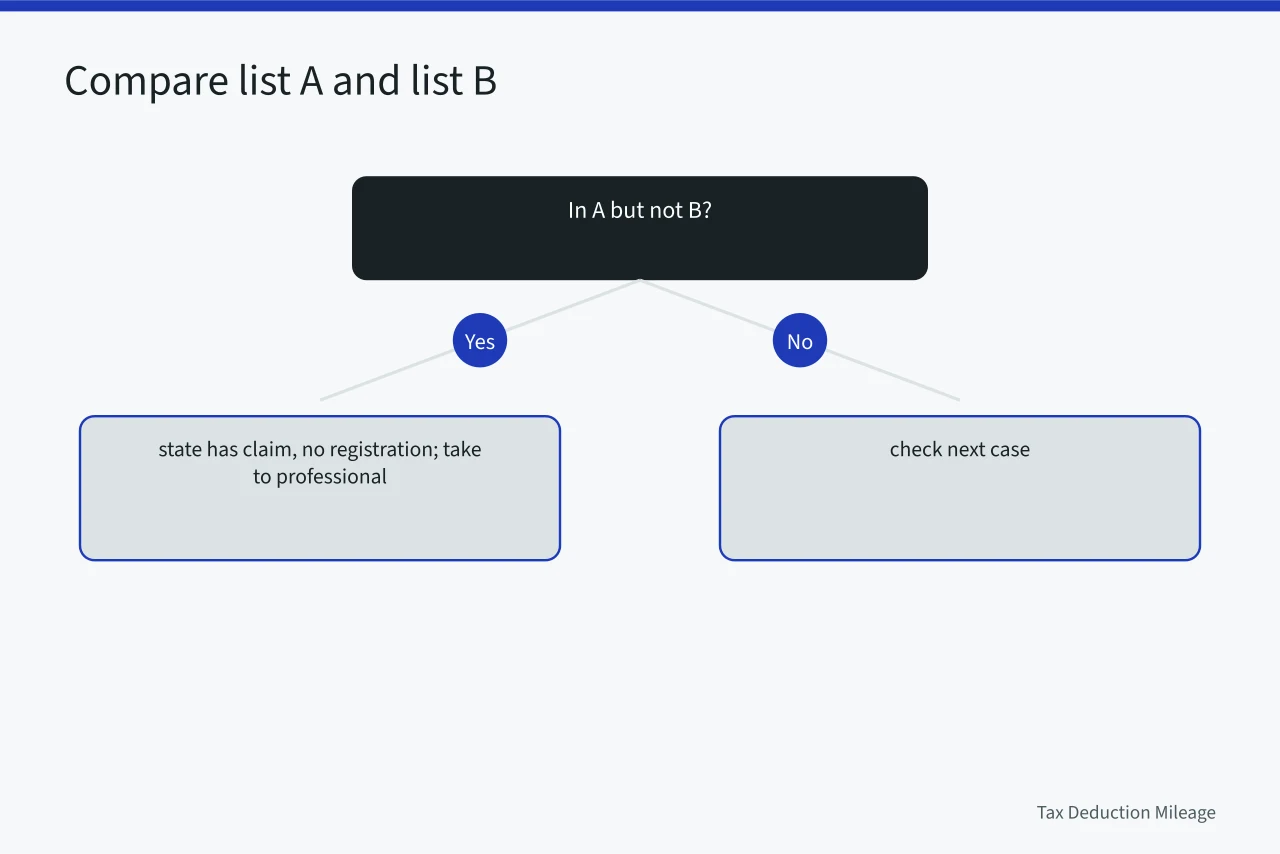
Where the money does not agree, trace one period end to end before you decide whether the collection or the return is wrong.
Example: a closed registration with a live deadline
A practice stops shipping into one state in March and closes nothing. The account stays open, the portal still lists monthly periods, and the first two returns after March go unfiled.
A notice arrives in September. The fix is small: file the nil returns, ask the state in writing to close the account, and record the date. That was nine months of an untracked deadline.
Accounts like that one are why the tracking layer matters. Deadline tracking software for tax preparers compared shows which tools watch a state portal and which only repeat what you typed in.
The preparer's own deadlines
Your practice carries deadlines that have nothing to do with a client's states. PTIN renewal runs on an annual cycle: the window opens in October for the following year and closes December 31, and the requirements sit on the IRS page for tax return preparers.
Electronic filing has its own closures. The IRS publishes e-file shutdown and availability dates for tax preparers, and a return finished after a shutdown can miss the state deadline it was meant to meet.
Reviewing a provider's deadline handling
You are not checking an outside preparer's arithmetic. You are checking that they hold the right state list and the right due dates.
- Ask which states they file for you, and compare that list to yours.
- Ask how each state's due date and extension rule reaches their calendar.
- Ask what happens when a period passes unfiled, and who notices.
- Ask what they are not doing, and name the person who does it.