
Guides
When client sales growth adds sales tax filing deadlines
A client's sales growth can add a sales tax filing duty or change its frequency. See the triggers, the thresholds to verify, and the notices that tell you.
What to take away
- A sales tax filing duty exists only where the client registered, or where a state decided it should have.
- Three questions decide whether a duty existswhere the client is present, what it sells, and who buys.
- Volume can create a duty once a state limit is crossed, so verify each state's own figure.
- Registration assigns a filing frequency, and the state can reassign it after reviewing sales.
- The state's own notice and portal outrank any compiled calendar, including your software's.
How a client's footprint creates a duty
A sales tax filing duty exists only where the client registered, or where a state decided it should have. Growth can move a client from the first case to the second without anyone noticing, which is why the practice needs the triggers written down.
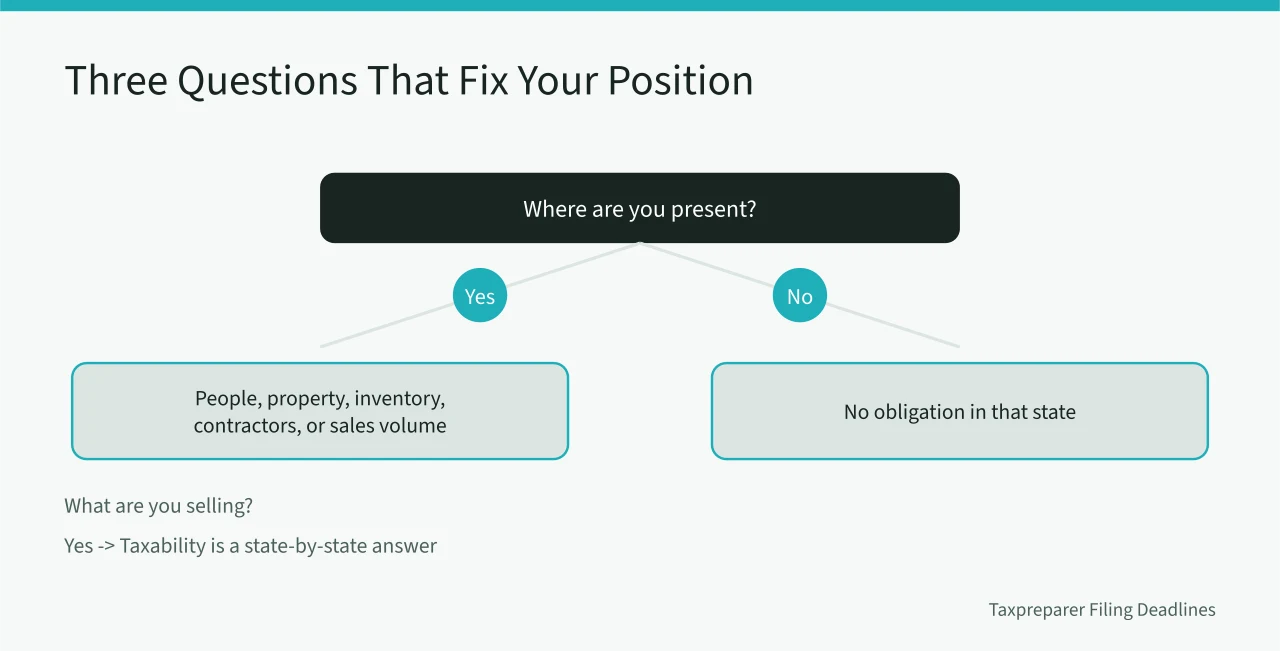
Three questions decide whether a duty exists: where the client is present, what it sells, and who buys. Presence can come from an office, a warehouse, inventory held by a marketplace, or a contractor acting for the client.
Thresholds that create a duty by volume
Volume matters too, since economic nexus rules create a filing duty once a state limit is crossed. The limit differs by state, so compare each client's sales in a state with that state's own figure, not with a national rule of thumb.
Common economic nexus figures are $100,000 in sales, 200 separate transactions, or both. A few states use $250,000 or $500,000. Treat the range as $100,000 to $500,000 and verify the state's rule before you tell a client it is safe.
Texas shows how a trigger turns into a date. A remote seller that exceeds the $500,000 safe harbor must obtain a permit and begin collecting and remitting state and local use tax. The deadline is the first day of the fourth month after the month it exceeds that amount.
The frequency a new registration brings
Registration assigns a filing frequency, and that frequency sets the shape of the year. A monthly filer produces twelve returns, a quarterly filer four, an annual filer one. The state can reassign the frequency after reviewing sales, and the change may not arrive in writing first.
What usually drives it
- Monthly
- Higher taxable sales, or a state default
- Quarterly
- Mid-range sales volume
- Annual
- Small volume, sometimes with a prepayment condition
What it asks of the practice
- Monthly
- Twelve returns and a month-end routine
- Quarterly
- Four returns due shortly after quarter end
- Annual
- One return and a prepayment schedule
Exact due dates vary by state and by the tax collected. Many states put the date near the twentieth of the month, but the registration notice is the authority. The patterns below show what a new frequency looks like on the calendar.
| State example | Frequency | Due date pattern | Concrete dates to write |
|---|---|---|---|
| California | Quarterly | Last day of month after quarter | Jan 31, Apr 30, Jul 31, Oct 31 |
| California | Monthly | Last day of month after month | Feb 28 for January, Mar 31 for February, Apr 30 for March |
| Texas | Quarterly | 20th of month after quarter | Jan 20, Apr 20, Jul 20, Oct 20 |
| Texas | Monthly | 20th of following month | Feb 20 for January, Mar 20 for February, Apr 20 for March |
| New York | Quarterly | 20th of month after quarter | Jan 20, Apr 20, Jul 20, Oct 20 |
| Ohio | Monthly | 23rd of following month | Feb 23 for January, Mar 23 for February, Apr 23 for March |
| Florida | Annual | January 20 | Jan 20 |
| Illinois | Annual | January 20 | Jan 20 |
These are representative, not universal. Confirm each date against the state portal. A Texas return filed through Webfile must be submitted by 11:59 p.m. Central Time on the due date, and a paper return must be postmarked on or before it.
For the state examples above, verify requirements with the California Department of Tax and Fee Administration (CDTFA), Texas Comptroller of Public Accounts, New York State Department of Taxation and Finance, Ohio Department of Taxation, Florida Department of Revenue, or Illinois Department of Revenue. Use the agency's official portal and the client's account notice to confirm the assigned schedule.
A quarterly client who drifts into monthly
A retail client registers in one state and files quarterly for two years. Sales grow past the state threshold, and the department reassigns the account to monthly.
The next return is due three weeks earlier than the practice expects, on a date the old calendar never held. A fresh look at assigned frequencies catches it in time.
The work of tracking sales tax filing deadlines in a tax preparation practice starts with one queue that names each client's state, frequency and portal. That queue is where a reassigned frequency gets noticed.
Reading the state notice when a change arrives
- Confirm the state, the account number and the taxpayer name on the notice.
- Record the frequency the state assigned, not the one you assumed.
- Find the effective date of any change, which is often later than the letter date.
- Note whether the client also collects a local or county component.
- Write the due date, the portal and the source into the practice calendar.
The steps take ten minutes per client, and sales tax filing deadlines for tax preparers: nine errors that cost practices covers the quarter that follows when nobody runs them.
What tells you the rules changed
Frequencies move when reported sales cross a threshold, and states reassign accounts with little ceremony. A rule change can also add a local component or move a date already on your list.
Two channels tell you first: the department's bulletin page and mail addressed to the registration. Read the mail within a week of arrival, every time, because a frequency change rarely announces itself twice.
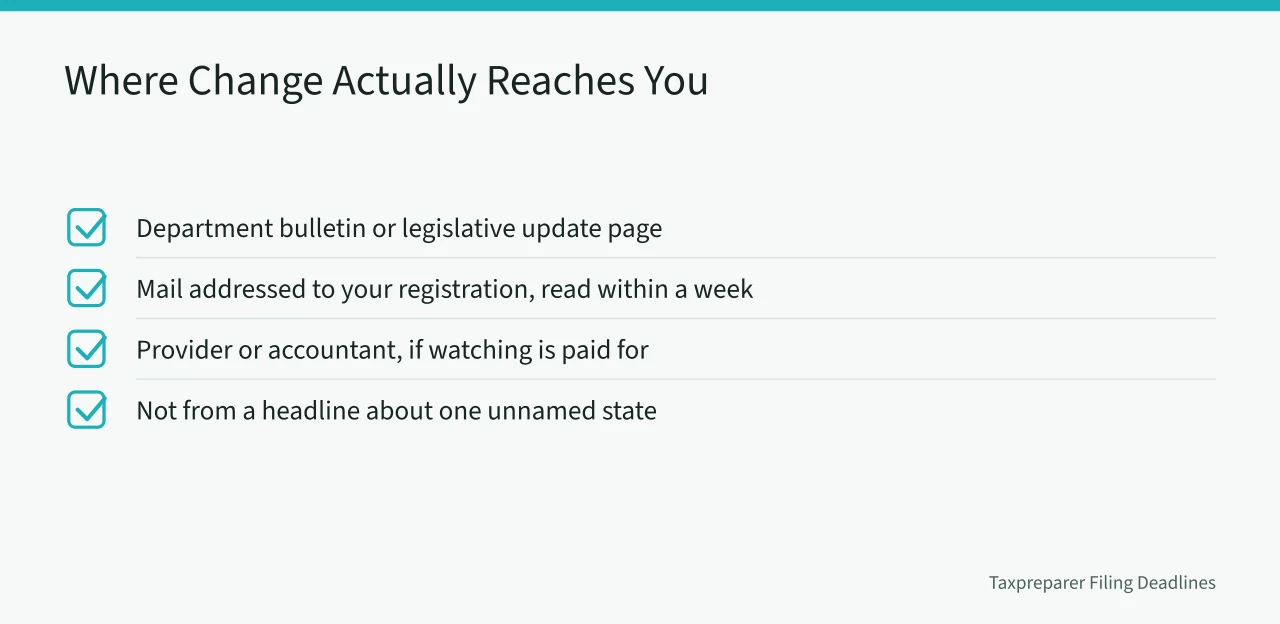
Named providers include Avalara Returns, TaxJar, Vertex Indirect Tax O Series, Sovos Sales and Use Tax, and Thomson Reuters ONESOURCE. Typical practice software stores due dates and reminders; it does not decide whether a new state registration is required.
For the yearly sweep that keeps the whole list current, see how tax preparers review sales tax filing deadlines each year.
Common questions
Which question decides whether a client owes sales tax filings?
Presence comes first, then what the client sells, then who buys. Skipping the first question is where bad advice starts, because the other two only matter once a state has a claim on the client.
How often does a filing frequency change?
States reassign it after reviewing reported sales, so a frequency set two years ago is unverified.
Do I file a zero return when there were no sales?
Often yes, where the state requires one. The portal states the rule, and skipping it carries the same penalty.
Can software carry these deadlines alone?
For due dates and reminders, largely. For whether a client should be registered somewhere new, no.