
Guides
Nine sales tax filing errors and how each becomes a bill
Nine sales tax filing errors a preparer meets in client files, each traced to the bill it produces: spent cash, backdated assessments, quiet filings or notices.
What to take away
- Each of the nine errors ends in a bill, and the bill arrives one of four ways: already spent, calculated backwards, recurring quietly, or by letter.
- Money a client collects as sales tax was never revenue, and spending it is the error that funds every other one.
- Presence in a state is a factual question with a state-specific answer, and intent does not enter into it.
- Missing exemption documentation usually leaves the seller holding the assessment.
- Every registration creates a filing duty that continues through quiet periods, so register only where a real duty exists.
- Only the first error is about cash. The other eight turn on where the client is present and what is held to prove what was done.
The nine errors and the bill each one sends
Every one of the nine errors is quiet when it happens and costly when it is found. Nothing breaks and no client complains, so the practice looks more profitable than it is. The correction arrives years later, calculated backwards, on money the client already spent.
| # | Error | How the bill arrives | What the file should hold |
|---|---|---|---|
| 1 | Treating collected tax as revenue | Cash is gone, liability remains | Collected tax kept apart in the books or a second account |
| 2 | Presence created without an office | Assessment calculated over every sale into the state | Presence list, state by state |
| 3 | Registering everywhere as a precaution | A filing duty every period, even with no sales | The test that justified each registration |
| 4 | Taxability answered by analogy | Wrong treatment in states where the client is present | Written basis for each state and product |
| 5 | Exemption claims without documentation | The seller holds the assessment | Signed certificate from the time of sale |
| 6 | Missing a change in the business | The client's position moves unnoticed | A scheduled yearly review |
| 7 | Assuming a marketplace covers everything | Own site, wholesale channel and invoices left uncovered | Written boundary and a channel map |
| 8 | Leaving dead registrations open | An open account expects returns | The closing filing and its deadline |
| 9 | Ignoring a notice from an unfamiliar state | Paying or answering before knowing why | The presence answer, in the same file |
Bill one: money already spent
The first error is the only one about cash, and it funds the rest. The bill is the full liability, due after the money has been used for something else.
1. Treating collected tax as revenue
It lands in the operating account, so the month feels strong. The money is held for a state. When the return falls due, the cash is gone and the liability remains. Practices that separate it, in the books or in a second account, almost never face the shortfall.
Bills calculated backwards
Five errors share one cost mechanism. The state works back over every sale it says was taxable. Presence errors produce the largest single assessments, since they are calculated back over every sale into that state.
2. Presence created without an office
A warehouse holding inventory, a remote hire, a contractor acting for the client, or the volume and nature of sales into a state can each create an obligation. Each state defines presence itself, and none of them ask what the client intended. A remote hire may also start payroll withholding at once, which the payroll tax mistakes article covers.
California shows what a volume test looks like. The CDTFA's economic nexus rule applies when total combined sales of tangible personal property for delivery in California by the retailer and related persons exceed $500,000 in the preceding or current calendar year. A retailer engaged in business there registers with the California Department of Tax and Fee Administration for a seller's permit.
4. Taxability answered by analogy
Treatment differs by state and by exactly what is sold, and services are handled inconsistently across the country. A competitor's treatment is not evidence. When a new product line appears, the answer has to be rebuilt for each state where the client has presence, and the basis written into the file.
5. Exemption claims accepted without documentation
A customer says they are exempt, the client believes them, and nothing is kept. At review, the seller generally holds the bill. A signed certificate on file at the time of sale is the difference between a clean file and an assessment. The file should show who certified what, and when.
6. Missing a change in the business
A new product line, a new fulfillment arrangement, a new marketplace, or a hire in another state can each move the client's position. None of them announce themselves as a tax event, so the review has to be scheduled rather than triggered.
7. Assuming a marketplace covers everything
A platform may handle tax on sales made through it. That says nothing about the client's own site, wholesale channel, or invoices. Get the boundary in writing, then map which channel each registration actually covers. The map is the proof that nothing falls between the platform and the client.
Bills that keep arriving
Two errors cost steady attention rather than one large sum. A registration creates a filing duty, and the duty continues whether or not the client sold anything in the period.
3. Registering everywhere as a precaution
This is the opposite of missing presence, and it is not free. Every registration creates a duty to file, including in periods with no sales. It converts an uncertainty into a permanent administrative load that lands on the preparer's calendar. Register where the presence test says a real duty exists, and write down which test it was.
8. Leaving dead registrations open
The client stopped selling into a state and stopped filing. The account did not close itself, and an open account generally expects returns. Closing it is a separate filing, and it has its own deadline. Add every open registration to the yearly review. When a return is missed anyway, follow the client missed tax deadline procedure.
The bill that arrives by letter
The last error is the only bill that announces itself, and the first reaction to it is usually wrong. The instinct is that the notice must be a mistake. Sometimes it is.
9. Ignoring a notice from an unfamiliar state
Either way, the answer is to find out why the state believes the client is there, before responding and before paying. That answer is a presence answer, so it belongs in the same file as the rest. If the client has been wrong for a while, take it to a CPA licensed in the states involved, promptly.
The pattern behind the nine
Only the first error is about cash. The rest turn on two questions a practice can answer once a year in an afternoon: where is the client present, and what is held to prove what was done.
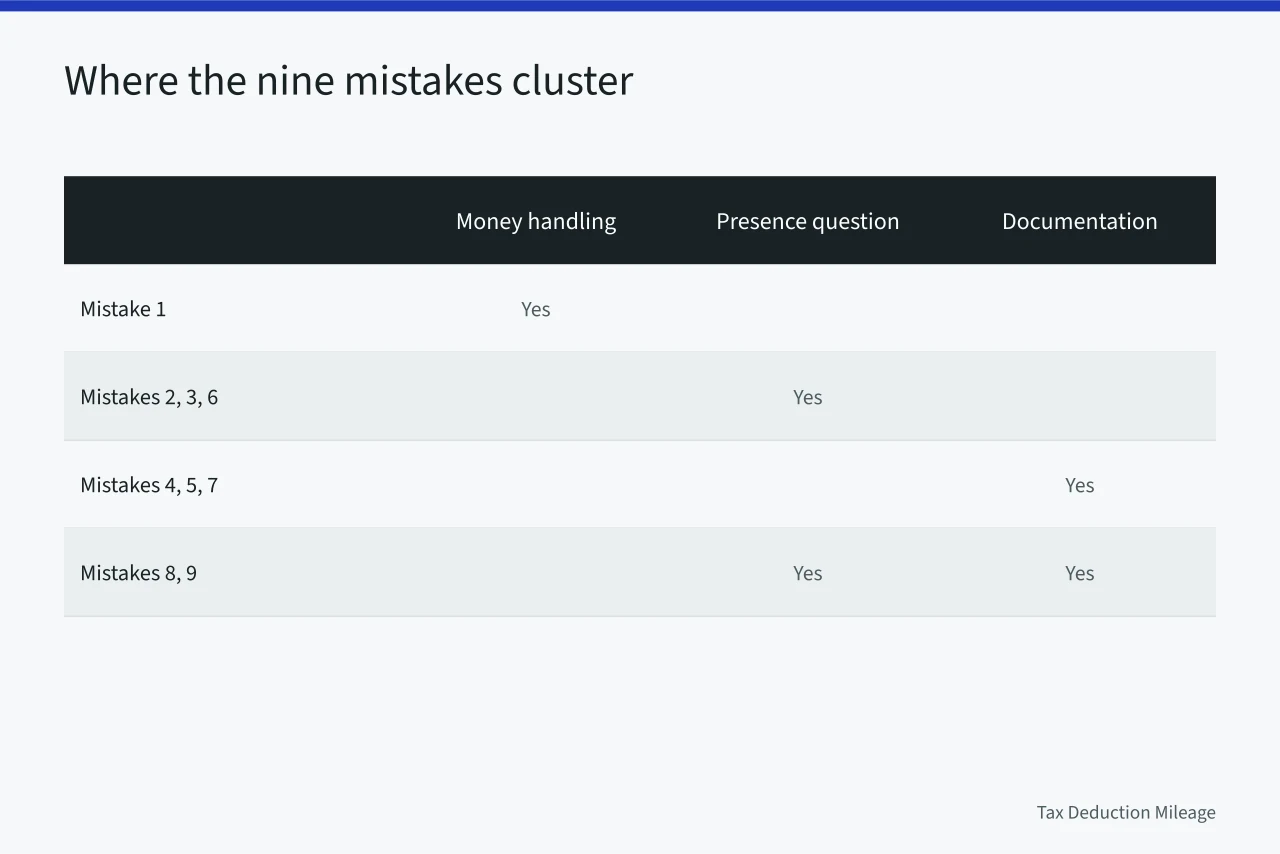
Errors 2, 3 and 6 are presence questions. Errors 4, 5 and 7 are documentation questions. Errors 8 and 9 are both, which is why a notice and a dead registration belong in the same yearly review.
Where the answers live
No single national source exists. Each state's department of revenue publishes its own rules and its own calendar. The IRS keeps a directory of state government websites that leads to each one, including information on taxation.
State due dates often differ from the federal ones, so read the state's own page before building any calendar entry from a summary of it. One state's dates in full are in sales tax filing deadlines in Texas. A practice that tracks every date in one place avoids the scramble after a missed filing, and deadline tracking software is one way to do it.
Common questions
Which of these errors is most expensive?
Treating collected tax as revenue, because the money is gone and the liability remains. Presence errors produce the largest single assessments, since they are calculated back over every sale into that state.
A client has been wrong for a while. What now?
Take it to a CPA licensed in the states involved, promptly. Options narrow as time passes, and voluntary correction is generally treated differently from discovery.
Can software prevent these?
Software handles rates and filings well. It does not decide where a client is present, whether a product is taxable there, or whether an exemption claim is valid.
Is there a safe default?
Separate the collected money, review the footprint once a year with a professional, and keep the documentation behind every exemption accepted.