
Guides
Payroll tax mistakes that experienced operators still make
Nine payroll mistakes, led by spending withheld money, plus the classification and location errors that stay silent until an agency writes to you.
Payroll punishes lateness more than inaccuracy. An arithmetic error gets corrected. A missed obligation compounds, and in one specific case it can follow individuals rather than staying with the business.
Here are nine payroll tax mistakes that still catch experienced operators, each with the form or the account it puts at risk.
For a tax preparer, each of these nine is a filing deadline risk. A missed payroll deposit becomes a notice. A misclassified worker becomes an amended return. An unclosed state account becomes a missing return.
This article lists nine payroll tax mistakes that experienced operators still make. Each one is framed as a filing deadline risk for a tax preparation practice: the return that goes unfiled, the deposit that goes late, the account that stays open.
The IRS and each state agency publish the forms and the deadlines that apply, and a payroll professional or CPA decides which of them fit the client. Use the nine as a checklist before filing season.
What to take away
- The withheld portion of pay was never the business's money. Every serious payroll consequence traces back to that one fact.
- Classification and location errors are silent. They produce no symptom until an agency writes.
- Registrations do not close themselves, and an open account expects returns.
- The forms and the calendar are where these mistakes surfaceForm 941 each quarter, Form 940 and the W-2 statements each year, and each state's own withholding return.
The nine
1. Using withheld money as working capital
The most serious error in this subject. Money withheld from someone's pay is held on behalf of a third party from the moment it is withheld, and it splits into the employee's income tax and the employee's share of Social Security and Medicare. That is what makes it a trust fund tax: under IRC §6672, the Trust Fund Recovery Penalty, the IRS can assess the unremitted amount personally against the individuals responsible for paying it, not only against the business. If the client's cash is short, speak to a professional before the payment that slips is the withheld one.
2. Classifying an employee as a contractor
Decided by the working relationship rather than by agreement. It is cheap until it is reclassified, at which point the obligations are calculated backwards: a worker paid on Form 1099-NEC, with the Form W-9 the client collected on file, turns into an employee who should have had a Form W-4 and a Form W-2. The factors are set out by the IRS in Publication 15-A and on its page for independent contractor or employee, and a worker or an employer can ask for a determination on Form SS-8. States often apply their own test as well.
3. Missing the state a worker actually works in
Withholding generally follows where the work is performed. A remote hire, a relocation, or a long assignment away from base can create obligations in a state nobody registered in, and that means a state withholding account, its registration, and its own return. Some neighboring states have reciprocity agreements that let a commuter withhold only at home, while a few, New York among them, tax a telecommuter's pay under a convenience-of-the-employer rule; California applies its own ABC test to classification.
4. Treating perks as though they sit outside pay
Some benefits are treated as pay and some are not. A taxable fringe benefit has to be added to wages, withheld from, and reported on the client's Form W-2, and introducing one without checking changes withholding for everyone who receives it. Found in the same year, it can be fixed on the next payroll; found later, it takes an amended Form 941-X and corrected W-2 statements.
5. Filing on the wrong deposit schedule
The schedule that applies to an employer is determined by rules, not chosen: the lookback period decides whether deposits are monthly or semiweekly, and a single day's accumulation above the next-day threshold forces a deposit by the next business day whatever the schedule says. Publication 15 spells out the lookback period and the next-day rule. Providers inherit whatever they were told at setup, and nobody rechecks it.
6. Leaving registrations open after they stop being used
A seasonal shutdown, a closed location, or a departed employee in a state the client no longer touches. The account stays open, and an open account generally expects returns, including ones showing nothing. Closing it is an active step: a notice to that state's revenue or employment agency, then any final return and annual reconciliation the state requires.
7. Not reading agency mail
Rate notices, schedule changes and account queries arrive by post and get filed unread. Most of them carry a response date, and missing it turns a question into an assessment or a lien. Almost every expensive payroll story includes a letter that sat in a drawer.
8. Assuming an owner is or is not on payroll
A sole proprietor's draw is not wages, a partner's guaranteed payments are not wages, and an S corporation shareholder who works in the business is generally expected to draw reasonable compensation on Form W-2. Whether an owner takes wages depends on how the business is treated for tax purposes. Guessing produces either an unnecessary payroll or an unreported one, and both take work to unwind.
9. Trusting a provider's totals without reconciling
The amount drawn from the client's account should equal what the reports say is due. Reconcile the quarterly Form 941 against the payroll register before it is filed, and the annual W-2 totals against the fourth-quarter 941. When the two do not match, that is not an administrative discrepancy to look at next month.
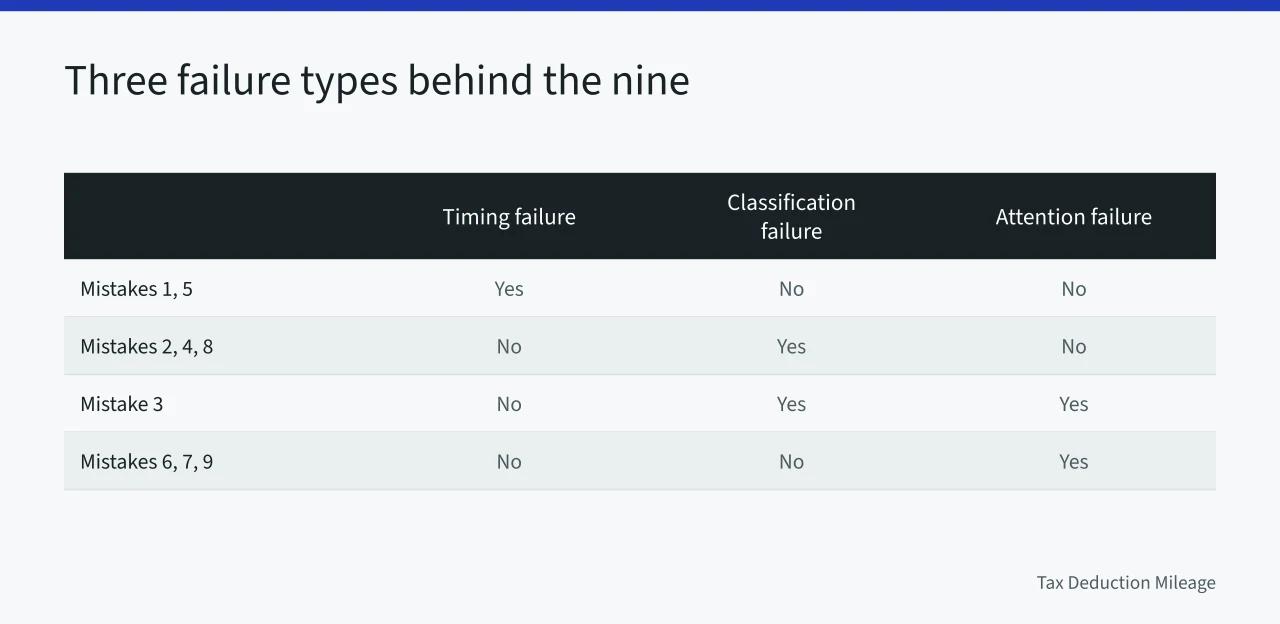
The pattern behind the nine
| Mistake | Timing failure | Classification failure | Attention failure |
|---|---|---|---|
| 1, 5 | Yes | ||
| 2, 4, 8 | Yes | ||
| 3 | Yes | Yes | |
| 6, 7, 9 | Yes |
Only one of the nine is really about numbers. The rest are about noticing: noticing that someone moved, that a perk changed the calculation, that an account is still open, that a letter arrived.
That is why the businesses which run payroll well are not the ones with the best software. They are the ones where somebody reads the mail.
Where the answers live
The federal half runs on named forms: Form 941 each quarter, Form 940 each year for unemployment, Form 944 or Form 943 for the employers those apply to, and the Form W-2 and Form W-3 at year end. The IRS's employment taxes pages and Publication 15 carry what has to be deposited, reported, and when, for the year the client is in. The state half is on each state's revenue department and its separate employment agency, and there is no national shortcut to it.
The payroll tax overview explains the process these nine break. Why a single hire can create a whole new footprint is in state business tax. Whether owners belong on payroll at all starts with entity tax treatment, and the calendar underneath all of it is in tax deadlines.
Why this matters in a tax preparation practice
In a tax preparer's practice, payroll mistakes rarely stay payroll mistakes. They become filing problems. A missing state registration turns into a missing return. A misclassified worker turns into an amended return and a deadline that has already passed. A deposit schedule error turns into a notice that arrives during peak season, when nobody has time to research it.
The practice operations lesson is calendar discipline. Put every payroll client's deposit schedule, state accounts, and owner compensation answers in one place. Review them before filing season, not after a notice. That way the filing deadline is a known date rather than a surprise. The nine above are the questions to ask when a client hands over payroll records.
Payroll obligations are filing deadlines too
Every mistake above eventually lands on a calendar the practice already keeps. Deposit dates, quarterly returns, annual returns, and each state's own withholding schedule all sit alongside the income tax deadlines on the same client list.
A practice that tracks only income tax filings will still miss these. Filing a return late does not repair a missed deposit.
The practical step is to add payroll obligations to the deadline list used for every other client filing. One list, reviewed monthly, with each client's deposit schedule and open state accounts recorded beside it. That is how a filing deadline stays a date on a calendar rather than a notice in the mail.
Common questions
Which of these is most expensive?
Number 1, without competition, because of what it can reach. IRC §6672, the Trust Fund Recovery Penalty, lets the IRS assess the withheld tax personally against the people responsible for paying it, so the exposure does not stop at the business. Number 2 is the most expensive of the ordinary ones, since it is recalculated backwards.
A client's provider handles everything. Is the client covered?
For mechanics, largely. For classification, location and owner questions, no. Those are judgment calls a provider will not make for the client, and the obligation stays with the business either way.
A client has one of these from a prior year. What now?
Take it to the appropriate professional promptly rather than deciding alone. For a prior-quarter employment tax error the route is usually Form 941-X, with corrected Form W-2 and Form W-3 statements and the state equivalent. Voluntary correction is generally handled differently from being found, and delay narrows the options.
How can a practice help clients stop these happening?
One person at the client owns the payroll calendar and reads every agency letter within a week. That habit alone prevents five of the nine.