
Guides
Why no payroll tax calculator replaces the nine-step sequence behind one
Why no payroll tax calculator replaces the nine-step sequence behind a payroll run, with the 2026 federal figures to check against, where each annual input comes from, and how to check a provider's numbers.
This page does not compute a paycheck for you. It sets out the nine steps, the 2026 federal figures you need to check a run, and why a generic calculator cannot replace the sequence. Rates and wage bases change, and state figures differ, so confirm each one against the source named below for the year you are running payroll.
What to take away
- Payroll arithmetic is a sequence, not a formula. Getting the order wrong produces a plausible answer that is wrong.
- Every input that changes annually is an input you must look up, not remember.
- The employer's own cost sits on top of what is withheld. Budgeting from gross pay alone understates the outlay.
- The IRS publishes the federal inputs each year and each state publishes its own. A payroll provider or CPA runs the actual numbers.
The sequence
Run in this order for one worker, for one pay period.
- Gross wages.The rate of pay times the hours worked, or the salary for the period.
- Pre-tax deductions.What comes out before tax, such as the worker's share of a health plan or a traditional retirement contribution.
- Taxable wages for withholding.Gross wages minus the pre-tax deductions. A traditional retirement contribution reduces income tax but not Social Security and Medicare. A health plan under a cafeteria plan reduces both.
- Federal income tax withheld.Figured from the worker's Form W-4 with the withholding tables in Publication 15 (Circular E).
- Social Security and Medicare withheld.The worker pays 6.2 percent Social Security up to the wage base, which is $184,500 for 2026, and 1.45 percent Medicare with no cap.
- Net pay.What is left for the worker after steps 4 and 5.
- The employer's matching Social Security and Medicare.The employer pays the same 6.2 and 1.45 percent again, on top of gross pay. Together the employer's share is 7.65 percent of wages up to the base.
- The employer's unemployment taxes.FUTA is 6.0 percent on the first $7,000 of each worker's wages. A credit of up to 5.4 percent for state unemployment paid on time brings the net rate to 0.6 percent in most states, and it is reported on Form 940 each year. The state unemployment contribution is at the rate in your state's notice, also on top of gross pay.
- Recording and depositing what is owed.The amounts withheld in steps 4 and 5 were never the employer's money. They go to the IRS with the employer shares from steps 7 and 8 on the assigned deposit schedule, through EFTPS, and are reported on Form 941.
Illustration only, with one worker, $1,000 of gross pay, and no income tax or benefits: employee Social Security is $62.00 and Medicare is $14.50, so net pay before income tax is $923.50. The employer adds $76.50 in matching taxes and $6.00 of FUTA, for a total cost of $1,082.50 before state unemployment. Federal income tax withholding depends on the Form W-4 and is not computed here.
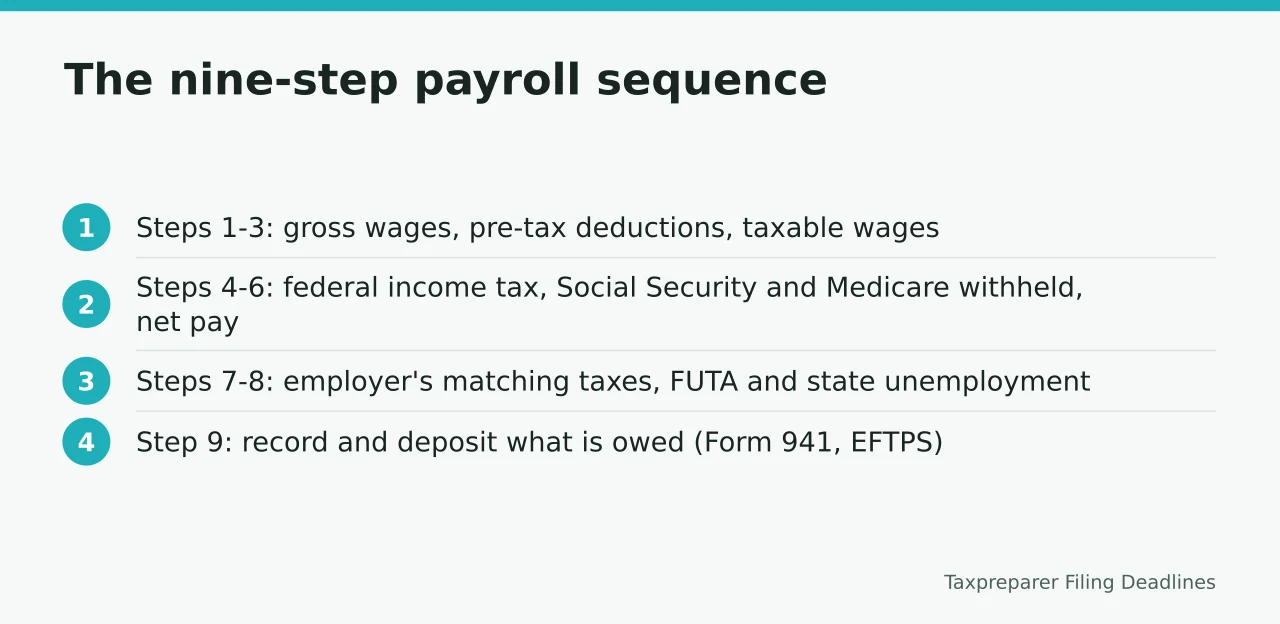
Steps 8 and 9 are where owner-run businesses get caught. Step 8 is a cost people forget to budget: the employer's own unemployment taxes sit on top of gross pay and are easy to leave out of a quote or a cash flow plan. Step 9 is where the habit runs the other way. The income tax and the worker's share of Social Security and Medicare leave the worker's pay but were never the business's money to spend.
Deposit timing and due dates
Your deposit schedule is set by the lookback period, which is the 12-month period ending June 30 of the prior year. If the tax reported for that period was $50,000 or less, you are a monthly depositor. Above $50,000, you are a semiweekly depositor.
- Monthly:deposits are due by the 15th of the following month.
- Semiweekly:wages paid Wednesday through Friday are due the following Wednesday. Wages paid Saturday through Tuesday are due the following Friday.
- The $100,000 rule:if your liability reaches $100,000 on any day, deposit by the next business day, whatever your schedule.
- Form 941:quarterly, due by April 30, July 31, October 31 and January 31. A quarter owing less than $2,500 can be paid with the return, but check Publication 15 for the current rule.
- Form 940:annual FUTA return, due January 31, or February 10 if every deposit was made on time.
What the calculation needs, and where each input comes from
What the calculation needs
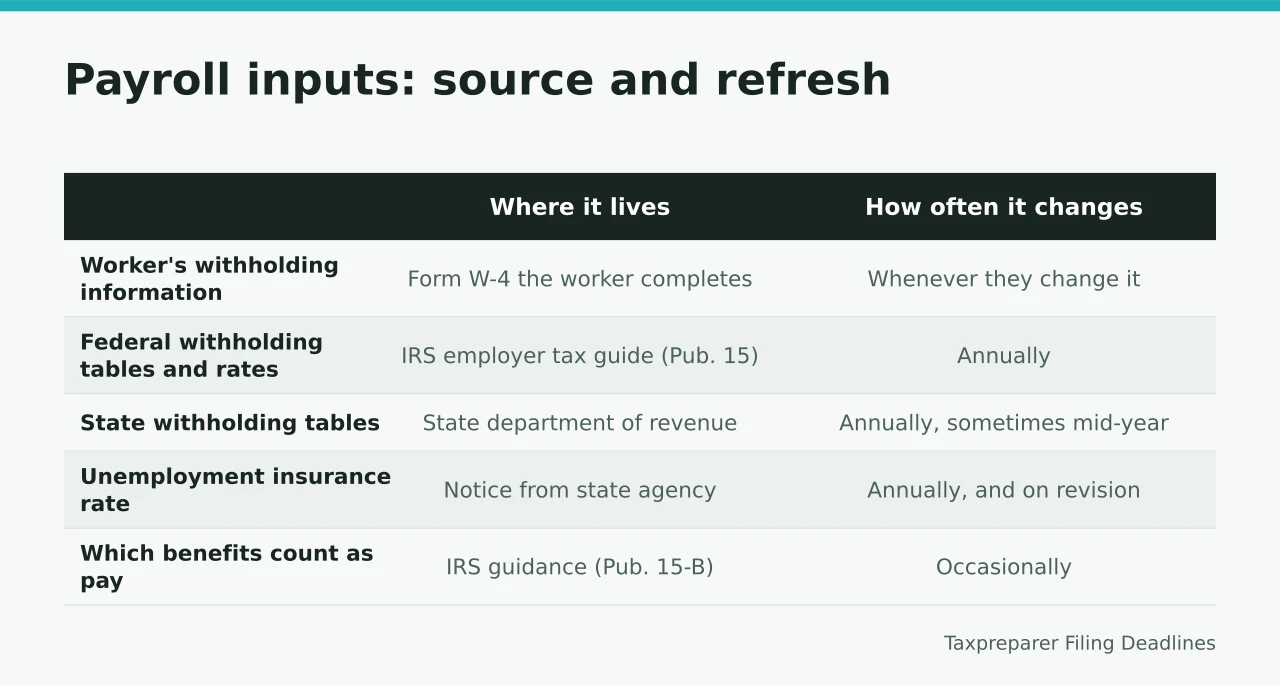
| Input | Where it lives | How often it changes |
|---|---|---|
| The worker's withholding information | The form the worker completes for you | Whenever they change it |
| Federal withholding method and tables | The IRS employer tax guide for the year | Annually |
| Wage bases and component rates | The same guide, for the year on its cover | Annually |
| State withholding tables | That state's department of revenue | Annually, sometimes mid-year |
| Your unemployment insurance rate | A notice from the state agency, addressed to you | Annually, and on revision |
| Which benefits are treated as pay | The IRS guidance on fringe benefits | Occasionally |
The IRS's employment taxes pages are the route to the federal half of that table. The core document is Publication 15 (Circular E), the employer's tax guide, which carries the year's income tax withholding tables, the Social Security and Medicare rates and wage bases, and the FUTA rate and wage base. The worker's withholding information comes from the Form W-4 the worker completes for you.
For the benefits row, the relevant material is Publication 15-B, which describes how various fringe benefits are treated. Read it before you promise anyone a perk.
On the state side, your state department of revenue supplies its withholding tables, and the state unemployment insurance agency sends the rate notice that sets your contribution rate. State rates and wage bases differ widely. The California Employment Development Department and the Texas Workforce Commission are two examples of that second kind of agency. The state layer is where most of the variation comes from; see state tax deadline differences for preparers.
Checking a calculation someone else produced
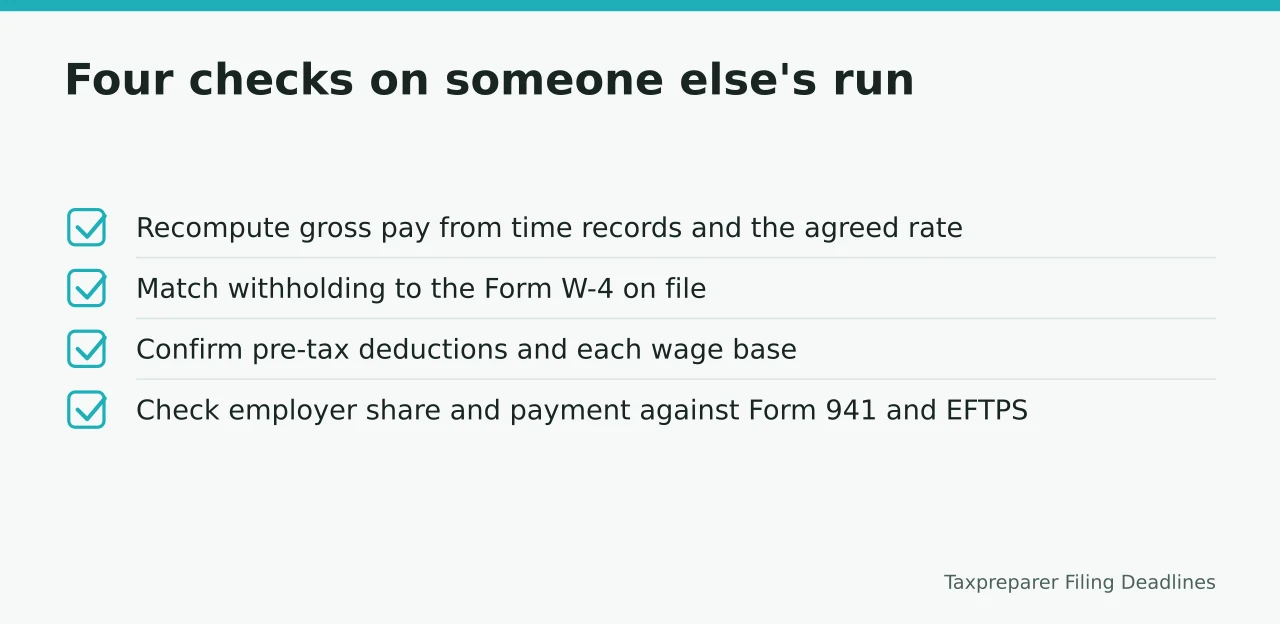
You do not need to reproduce a payroll run to review one. Four checks catch most errors.
- Recompute gross pay from the time records and the agreed rate, and confirm the pay period and the hours.
- Match the withholding to the Form W-4 on filefiling status, dependents or extra amount, and any change since the last run.
- Confirm the pre-tax deductions came out in the right order, so the income tax withheld and the Social Security and Medicare withheld each match their own wage base.
- Check the employer's share and the payment, meaning the matching Social Security and Medicare, FUTA and the state unemployment contribution, against Form 941 and the deposit record in EFTPS on the assigned schedule. Common payroll tax mistakes show up here first.
Why a generic calculator misleads
A calculator that does not know your state, your worker's withholding information, your benefit arrangements and your assigned unemployment rate is producing an illustration. It is fine for a rough sense of scale and useless for anything you act on.
The IRS Tax Withholding Estimator is a useful tool for an individual's income tax withholding. It does not compute the employer's taxes in steps 7 and 8, and it is not a payroll calculation.
The worst outcome is not an inaccurate number. It is an accurate-looking number that becomes the basis for a hiring decision, a quote to a client or a cash flow plan.
The PTIN and Circular 230 overview covers the professional rules that surround this work. The federal and state filing calendar sets out the dates the deposits and returns must meet.