Guides
Fair-margin pricing for tax preparation services for new owners
Fair-margin pricing for tax preparation services helps new owners set fees from cost per return and a target margin, then test the number across a full season.
What to take away
- Price from cost per return plus a target margin, not from what the office down the street charges.
- A 1040 with two schedules and a small business return are different products; price them apart.
- Know your break-even return count before the season starts, not in April.
- Quote in writing, with the scope named, so an added schedule is a change order and not a free hour.
- Raise prices on new clients first and let existing clients keep last year's rate for one season.
Fair-margin pricing for tax preparation services rests on three numbers: cost per return, target margin and break-even count. The figures below are typical 2026 ranges, labelled as ranges because vendors and markets set their own.
This article covers practice economics, not tax positions. For advice on a specific return, a client's facts or a credential question, work with a licensed CPA or Enrolled Agent, or the IRS.
Cost per return is the number you start from
Add what you pay out per return: software fee, e-file charge, a bank product fee if you use one, and any per-return share of insurance. Call that direct cost.
Cost per return: key figures
- $20–$30pay-per-return federal fee
- $400–$1,500unlimited season packages
- $10–$25per state return
- $25–$50bank fee per refund transfer
Tax software sets most of that number. Drake Tax's pay-per-return option typically costs $20 to $30 per federal return. Unlimited season packages from Drake, TaxSlayer Pro, ATX or ProSeries commonly run $400 to $1,500, depending on states and add-ons.
Suites such as Lacerte, UltraTax CS and ProConnect Tax sit above that, typically starting near $2,000 a season for a small practice.
Many vendors bundle federal e-filing and charge per state return, typically $10 to $25. If you sell refund transfers or advances, the bank usually takes $25 to $50 per return.
Errors-and-omissions insurance for a solo practice typically runs $500 to $1,500 a year. Across 100 returns that is $5 to $15 each.
Then add the overhead that does not move with volume:
Cost per return
- office rent
- utilities
- your own software subscriptions
- continuing education
- PTIN renewal, currently $19.75
- staff wages for the season
Divide that total by the number of returns you expect to file. That is your overhead per return.
Say the season costs $24,000 in overhead and you expect 300 returns. Overhead is $80 per return. Add $35 of direct cost and your floor is $115.
Direct cost plus overhead per return is your floor. Price under it and volume makes the loss bigger, not smaller.
Set the margin before you set the price
Decide the margin you want on each return type, then work backward. If a return costs you $90 to produce and you want a 40 percent margin, the price is 90 divided by 0.6, or $150. Substitute your own cost and your own target.
Margin math by return type
Simple return
- Cost to produce
- $90
- Target margin
- 40%
- Formula
- 90 ÷ 0.6
- Price
- $150
Schedule C return
- Cost to produce
- $180
- Target margin
- 50%
- Formula
- 180 ÷ 0.5
- Price
- $360
Run the same math on a Schedule C return that costs $180 to produce at a 50 percent target. The price is 180 divided by 0.5, or $360. Typical ranges in most markets sit near $400 to $900 for that return, so the formula holds if your cost figure is real.
New practices usually start lower than they should. A margin under 30 percent leaves nothing for the software price increase, the client who calls four times, or the return you redo in June.
Price by return type, not by one rate
A simple 1040 with the standard deduction is not the same product as a Schedule C with mileage and a home office, and neither is a partnership return with a K-1. Build a short list of return types you actually see, and give each one a price.
Pricing by return type
Return type
- Simple 1040, W-2 only
- $150–$300
- 1040 with Schedule C
- $400–$900
- 1040 with Schedule D
- $350–$700
- Rental property return
- $300–$600 per property
- S corp or partnership
- $800–$2,500
- Amended return
- $150–$300 per hour
- Prior-year catch-up
- $200–$450 per year
- Nonresident return
- $300–$600
Typical price
- Simple 1040, W-2 only
- 1040 with Schedule C
- 1040 with Schedule D
- Rental property return
- S corp or partnership
- Amended return
- Prior-year catch-up
- Nonresident return
Price by return type
| Return type | What drives the time | Pricing shape that fits |
|---|---|---|
| Simple 1040, W-2 only | Data entry, one or two forms | Flat fee, typically $150 to $300 |
| 1040 with Schedule C | Bookkeeping quality, mileage records | Flat fee plus a per-schedule charge, typically $400 to $900 |
| 1040 with Schedule D and several 1099s | Brokerage statements, basis cleanup | Flat fee, typically $350 to $700 |
| Rental property return | Depreciation schedule, prior-year carryovers | Flat fee set after a document review, typically $300 to $600 per property |
| S corporation or partnership | Trial balance, K-1s, basis tracking | Quoted per entity, billed at delivery, typically $800 to $2,500 |
| Amended return | Reconstructing what was filed | Hourly with a stated minimum, typically $150 to $300 an hour |
| Prior-year catch-up, multiple years | Volume of missing documents | Per-year fee, quoted as a package, typically $200 to $450 a year |
| Nonresident return, 1040-NR | Treaty positions, foreign income | Flat fee, typically $300 to $600 |
Hourly billing suits diagnostic work where you cannot see the end. It fits badly when the client is watching the clock instead of the result.
Quote in writing and name the scope
A quote should list the forms you will prepare, the documents the client must send, the deadline you are working to, and the fee. Anything outside that list is a change order.
This is where most new practices lose margin. The client adds a rental property in March, you absorb the hours, and the fee stays where it was. A written scope turns that conversation into a short email instead of an argument.
The FTC's guidance on advertising claims for small business applies to how you describe your own fees. A claim like "the lowest price in town" has to be true and supported.
Run the break-even before the season
Break-even return count is total fixed costs divided by the margin you earn per return. If your season costs $30,000 to run and you clear $120 of margin per return, you need 250 returns before you make anything for yourself.
Break-even return count
- 250$120 margin
- 120$250 margin
At $250 of margin per return, the same season breaks even at 120 returns.
That number tells you whether the season is viable at your current price, and it tells you how many returns you can turn away. A practice that takes every return at a low fee can hit its break-even count and still finish the season with nothing.
Discounts need a reason and a name
Write down who can approve a discount, the largest one allowed, and the reason it was given. Track them by reason and by approver. A common cap is 10 percent off, approved by the owner only.
Untracked discounts are how a pricing policy quietly disappears. A discount given to solve a service problem is a fee cut that did not fix the problem. If you discount for a referral source or a family member, record it as that.
Keep records that support the price
Your records need to show income and expenses clearly, and support what you bought, sold and paid. The IRS page on what records to keep sets out the standard. Cost records are what let you reprice next year from evidence instead of memory.
Who needs a PTIN, and why it matters to your rate
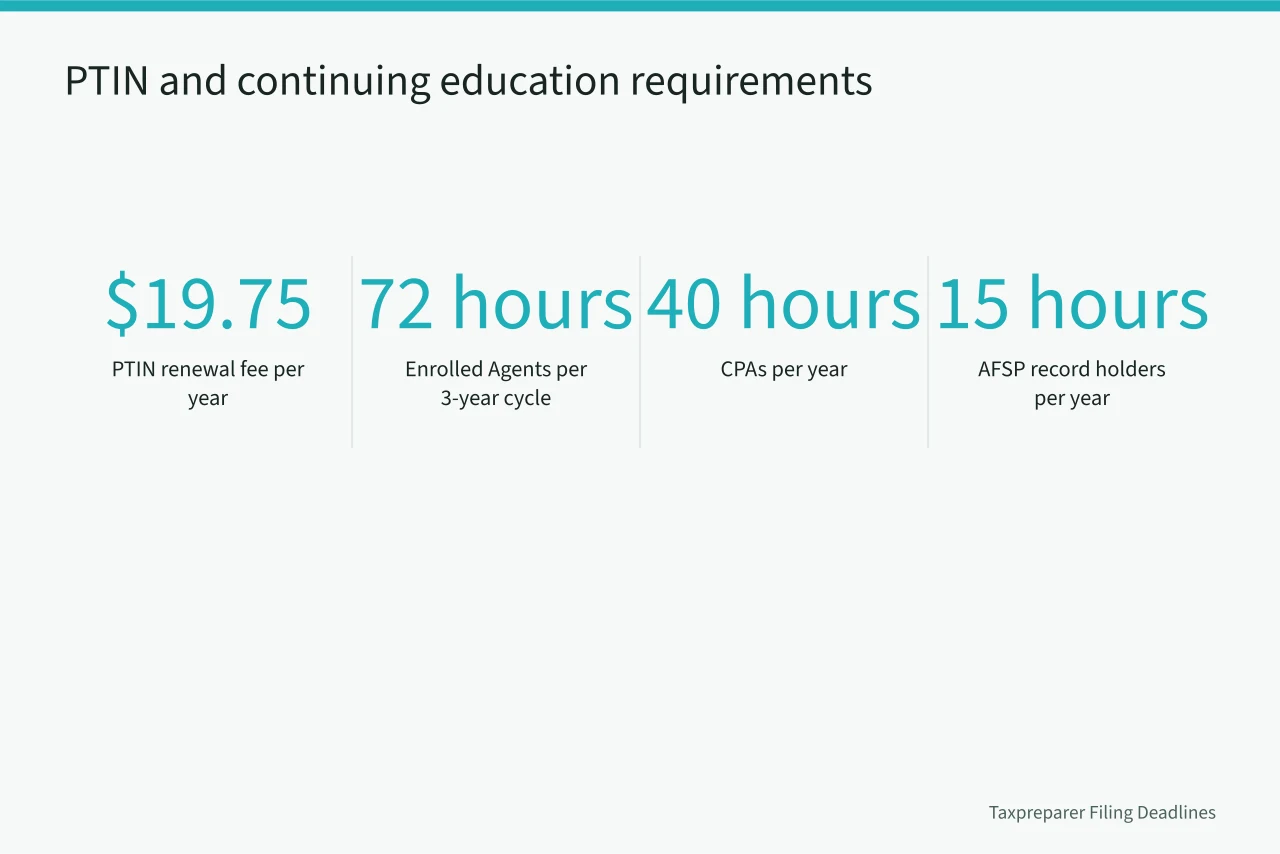
Anyone paid to prepare or substantially assist in preparing a federal return generally needs a PTIN, and each preparer needs their own. A bookkeeper who only gathers and records client information generally does not. The IRS PTIN FAQ covers the distinction. Renewal runs $19.75 a year.
This affects pricing because a credentialed preparer costs more per hour than a data-entry clerk. The return type should decide who touches it, and the price should cover the person who signs it.
Continuing education feeds that hourly rate too. Enrolled Agents owe 72 hours per three-year cycle, with at least 16 a year. CPAs typically owe 40 hours a year under state boards, and AFSP record holders owe 15.
Raise prices on a schedule
Pick one date a year to review prices. Apply the increase to new clients immediately and hold existing clients at last year's rate for one season, then move them.
Software renewals typically climb 5 to 10 percent a year. Two seasons at a flat price is a margin cut you chose.
Test the change on a small group first. Write down the result you expect and the earliest sign it is going wrong, then compare. If conversion drops hard on new quotes, the price is above what your market will bear. If nobody objects, it was too low.
For the return types that carry the most margin, see the most profitable tax preparation services.
Common questions
How do I price a return I have never prepared before?
Quote it hourly with a stated minimum, and tell the client the fee may change once you see the documents. After you finish, record the hours it took and turn it into a flat fee for the next one.
Should I match the cheapest preparer in my area?
No. That price is set by someone else's cost structure, which you cannot see. Price from your own cost per return and your target margin, then decide whether you can serve that part of the market at all.
When should I raise prices?
Once a year, on a set date. Start with new clients, hold existing clients for one season, and watch conversion on new quotes to see whether the market accepted the change. A 5 percent raise on new quotes is a reasonable first step.
What if a client refuses the quoted fee?
Offer a smaller scope at the lower fee, such as a return without the business schedule, and let them decide. Cutting the fee while keeping the full scope is the loss you were trying to avoid.