Guides
When a US firm hires in Canada or Mexico: IRS, CRA and SAT payroll filing duties
The article explains the IRS, CRA and SAT payroll filing duties a US firm takes on when hiring in Canada or Mexico and how to organize them from an inventory.
What to take away
- A US employer paying a resident of Canada for work performed in Canada generally needs a CRA payroll account before the first payday.
- A US employer with a Mexican payroll generally needs an RFC with the SAT, plus IMSS and INFONAVIT registration for social security and housing contributions.
- The IRS clock does not stop because a worker sits abroadForm 941, Form 940 and the W-2 schedule still apply to US-source wages.
- Form I-9 covers every employee working in the United States, including Canadian and Mexican nationals, and reverification is due when work authorization expires.
- Build the calendar from an inventory of entities, employees and registrations, then attach dates. A date list goes stale at the first new hire.
This article is for US tax preparation practices that keep filing calendars for business clients. Cross-border hiring adds CRA, SAT, IMSS, T4 and I-9 dates to the same client file that already holds Form 941, Form 940 and state payroll returns.
The preparer does not run foreign payroll. The preparer inventories the client's hiring events, maps each event to a filing or registration deadline, and reviews the calendar before the first payday. That is practice operations: a taxpreparer, a client, and a deadline that must not slip.
Read employer as the tax preparer's client, and read every cross-border rule as a calendar item to monitor.
For a tax preparation practice, these cross-border rules are not a separate service line. They are filing deadlines, registration triggers and information returns that belong in the same client calendar as Form 941, Form 940 and state payroll returns.
A preparer with a US client that hires in Canada or Mexico can use this article to inventory which clocks apply. Then map each one to a due date, a lead time and an owner.
The practice value is in the review. Confirm the work location, check the registration status, and put T4, SAT, IMSS and I-9 dates on the calendar before the first notice arrives. Keep the inventory with the client's tax file so the next hire does not reset the work.
For a tax preparation practice, cross-border hiring is a deadline management problem. The work is not to run payroll for a foreign affiliate. The work is to keep the client's filing calendar complete when a new hire in Canada or Mexico adds CRA, SAT, IMSS, T4 or I-9 dates.
This is tax preparation practice operations: a taxpreparer, a filing deadline, and a client file that stays current. For the rest of this article, read employer as the tax preparer's client.
That means a client inventory, a clear owner for each date, and a review step before the first payday. Put the cross-border dates next to Form 941, Form 940 and state payroll returns. Then bill the monitoring as part of the practice's compliance calendar service. The next hire should update the same file, not restart the research.
Three tax authorities, three clocks
A US firm that hires across a border ends up answering to three tax authorities. The IRS collects on US-source wages. The Canada Revenue Agency collects source deductions on work performed in Canada. Mexico's SAT collects income tax withholding and the payroll filings that go with it.
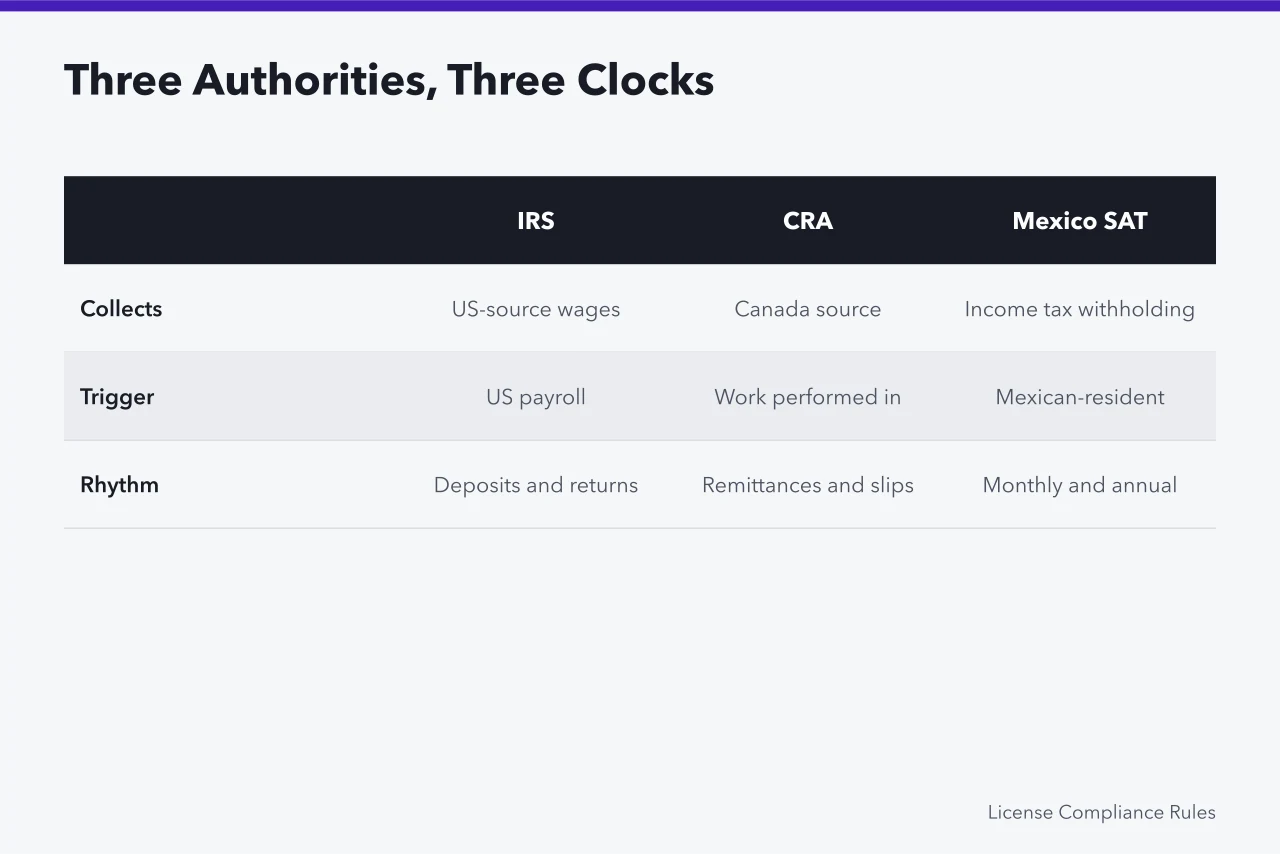
Each authority sets its own registration trigger, deposit rhythm and information return. None of them coordinates with the others. That is the whole difficulty: one hire can start three filing obligations, and missing one is invisible until a notice arrives.
The trigger is almost never the signed contract. It is a person performing work in a jurisdiction. A Canadian resident working from a home office in Ontario for a Seattle employer creates Canadian source income even though the company has no Canadian office.
What starts a filing duty
Canada treats a US employer as an employer for source deductions once it pays a resident for work performed in Canada. That duty attaches to the pay, not to a lease or a branch.
Mexico takes a similar view. A US firm with a Mexican-resident employee, or with a permanent establishment there, generally needs an RFC and a payroll arrangement inside Mexico.
Remote work does not soften either rule. The location where the work is performed decides, not the location of the manager or the payroll system.
US state rules layer on top of all three. California, New York and Washington tax wages for work performed in the state, including for nonresidents. Texas has no personal income tax but still runs unemployment tax. A federal-only calendar misses every one of these.
What city and county licenses rules 2027 involves in practice is four separate objects, and each answers a different question: what to register, what to file, what to pay and what to prove.
IRS dates for cross-border payroll
The IRS clock runs on deposits, quarterly returns and annual information returns. A US employer with staff abroad files the same forms as a domestic one, with closer attention to total payroll and worker status.
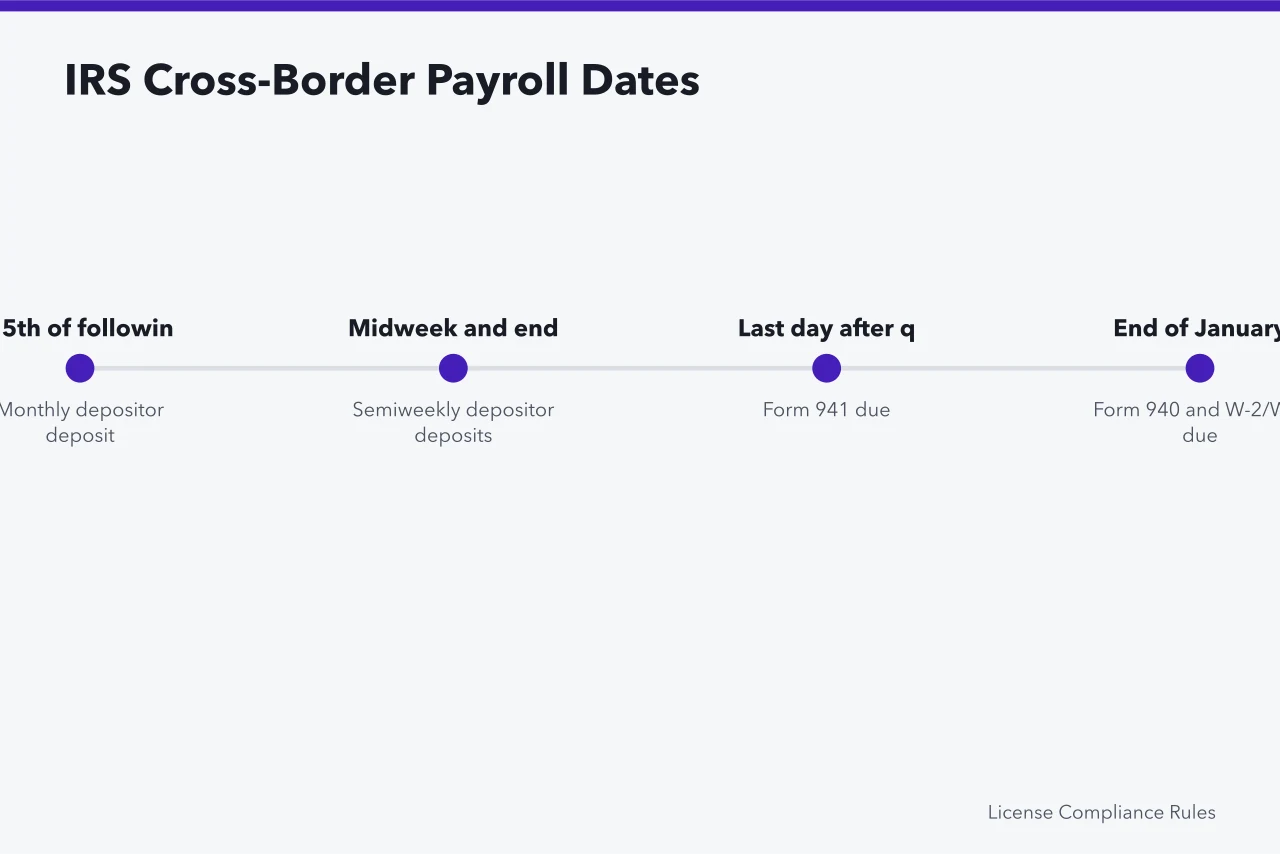
Federal income tax withholding, Social Security and Medicare follow the deposit schedule in Publication 15 (2026), (Circular E), Employer's Tax Guide. That guide sets the deposit rules, the lookback period and the forms.
Monthly depositors generally pay by the 15th of the following month. Semiweekly depositors follow the midweek and end-of-week schedule. Next-day depositors act after a large payroll. The employer's own deposit history decides which applies.
Form 941 is due quarterly, usually the last day of the month after the quarter closes. Form 940, the federal unemployment return, is annual and generally due at the end of January. W-2 and W-3 go to the Social Security Administration on the same January rhythm.
Adding foreign payroll can push an employer across a deposit threshold and move it from monthly to semiweekly. That shift is easy to miss in the first year, and the penalty for depositing late at the new frequency is not small.
A treaty may change what the worker owes. It does not change what the employer files. Foreign nationals on US-source wages stay on the US payroll.
Canada: CRA registration and remittances
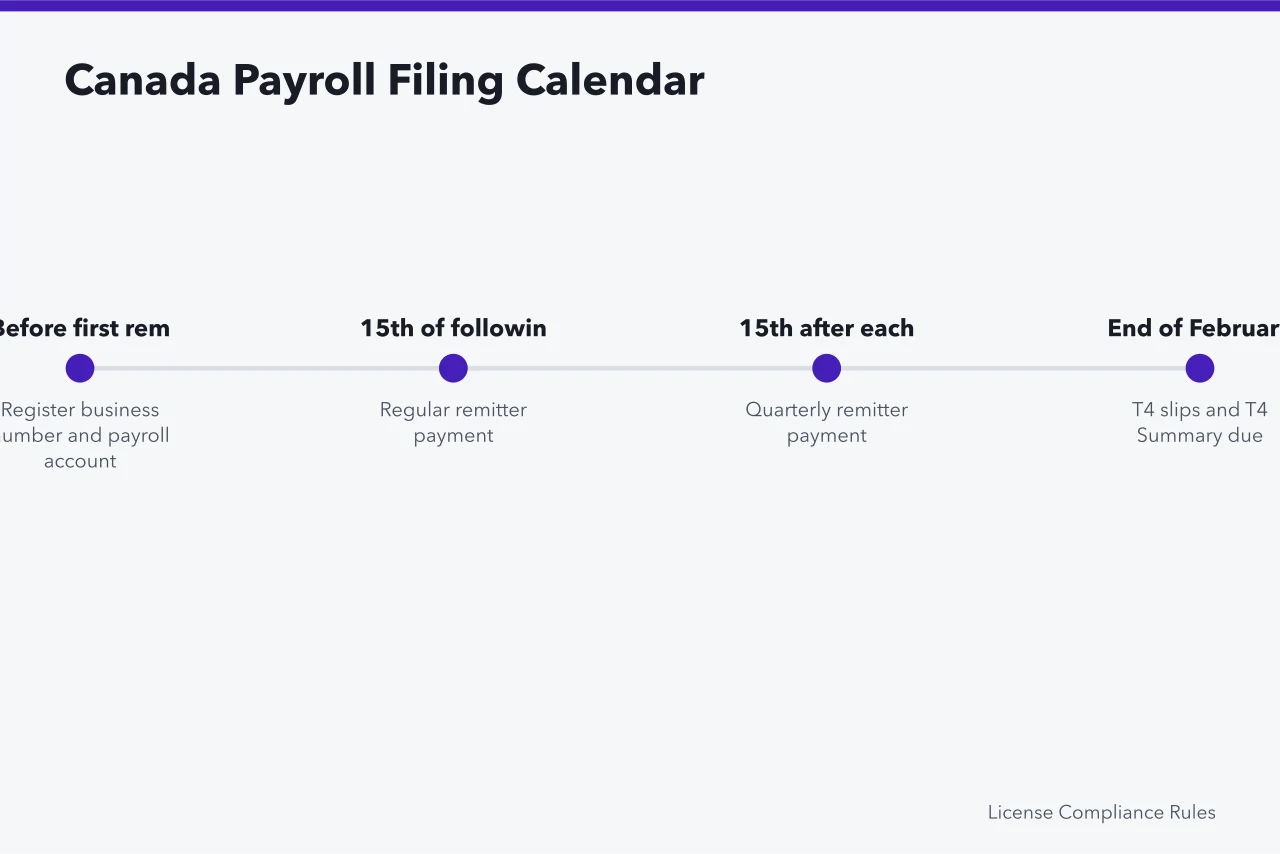
Canada starts with a business number and a payroll account. A US employer that pays a resident for work performed in Canada usually needs both before the first remittance. The CRA publishes the registration steps through Business and industry - Canada.ca.
Source deductions cover federal and provincial income tax, Canada Pension Plan contributions and Employment Insurance premiums. The employer withholds from each pay and remits to the CRA.
Remittance frequency follows average monthly withholding. Regular remitters pay by the 15th of the following month. Quarterly remitters, with small withholdings, pay by the 15th after each quarter. Accelerated remitters pay sooner, sometimes within days of a payday. The CRA assigns the category.
T4 slips and the T4 Summary are annual, generally due at the end of February for the prior calendar year. A US employer with Canadian staff issues T4s even when the payroll system sits in the United States.
A Record of Employment is issued when an employee stops working, takes leave or has a break in earnings. Service Canada uses it to administer benefits, and the deadlines are short.
Provincial levies sit on top. Ontario, Quebec and Manitoba run employer health taxes or similar charges. Quebec files separately through Revenu Quebec, so a firm with staff in Montreal tracks two systems, not one.
Mexico: SAT registration and employer contributions
Mexico's tax authority, the SAT, requires an RFC for the employer and for each employee. A US firm with a Mexican payroll usually needs a Mexican legal presence or a registered employer arrangement. The RFC anchors every filing that follows.
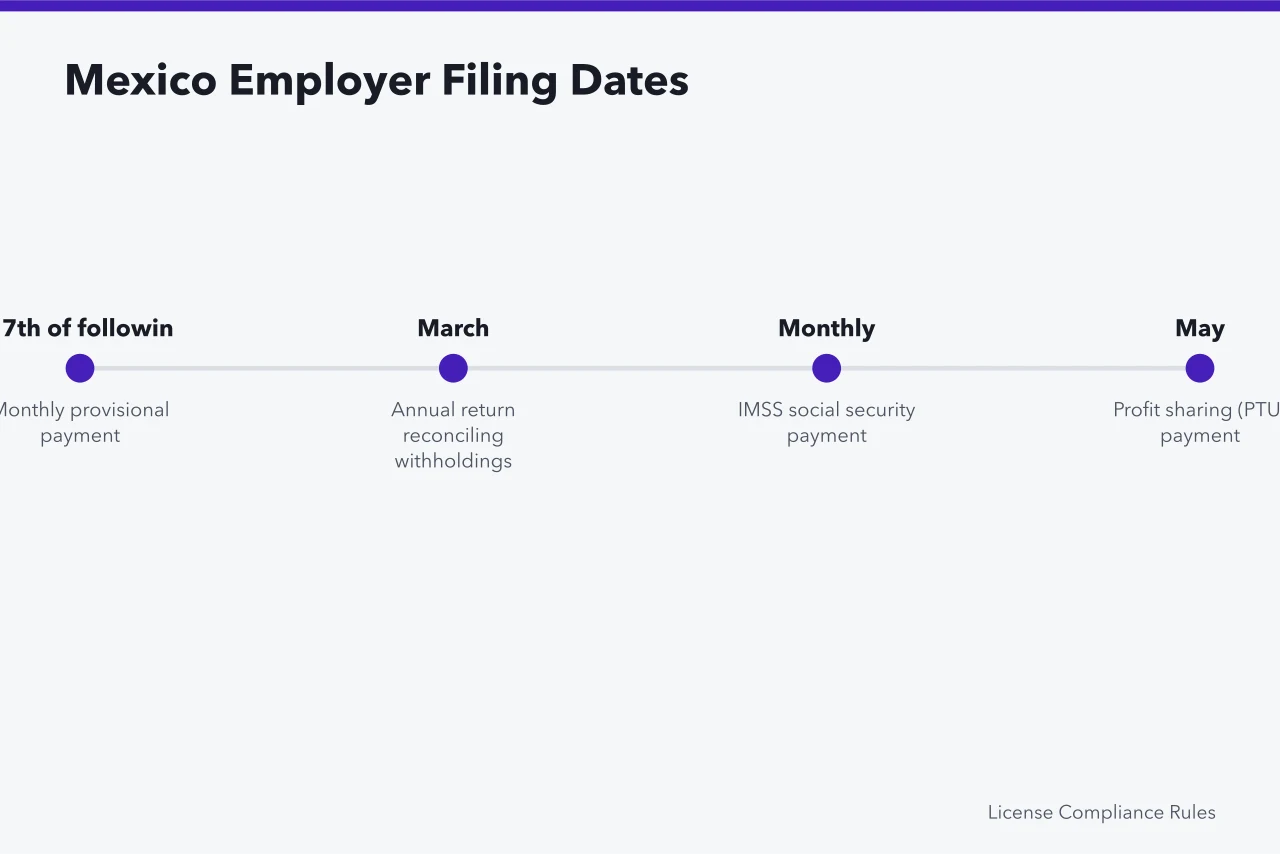
Monthly provisional payments are generally due by the 17th of the following month, with the date shifting when the 17th lands on a weekend or holiday. The employer withholds income tax and remits it alongside any value-added tax tied to the business.
Annual returns follow in March for most employers, reconciling the year's withholdings. Employees may file their own returns; the employer's filing is separate and still required.
IMSS registration covers social security, paid monthly. INFONAVIT, the housing fund, adds another employer contribution and its own registration. State payroll tax is a third obligation, levied by many Mexican states at locally set rates and dates. A firm with staff in Nuevo Leon or Jalisco checks the state calendar, not just the federal one.
Electronic accounting and CFDI invoicing run through the same system. A US payroll platform often cannot issue CFDIs, so a Mexican provider handles the receipts and returns.
Profit sharing, or PTU, is an employer cost rather than a withholding. It is generally payable in May, with the deadline varying by entity, and it belongs on the calendar next to the monthly items.
USMCA labor duties and professional entry
The USMCA replaced NAFTA as the governing agreement among the three countries. For employers, the labor provisions matter most, and the Department of Labor administers the US side through its wage and hour programs.
The agreement includes a facility-specific rapid response mechanism for Mexico. A US employer with operations there can face a review if workers allege a denial of rights, and the remedy can include suspension of tariff benefits for that facility.
The practical duty for a US firm is to know the labor conditions at any Mexican facility in its supply chain. Using a Mexican contract manufacturer does not create automatic liability, but it can draw the company into a review. The Department of Labor maintains the process through the United States-Mexico-Canada Agreement (USMCA) | U.S. Department of Labor.
Canada's obligations under the agreement are less enforcement-heavy. Canadian staff remain covered by provincial employment standards for hours, overtime and termination.
The agreement also keeps a temporary entry category for certain professionals moving among the three countries. Wage and hour rules apply to foreign workers inside the United States regardless of immigration status, and the Wage and Hour Division Administered Immigration Programs | U.S. Department of Labor sets out the employer duties.
USMCA sets no withholding rate and no filing date. It adds labor and trade duties that sit alongside the three tax calendars.
I-9 and work authorization tracking
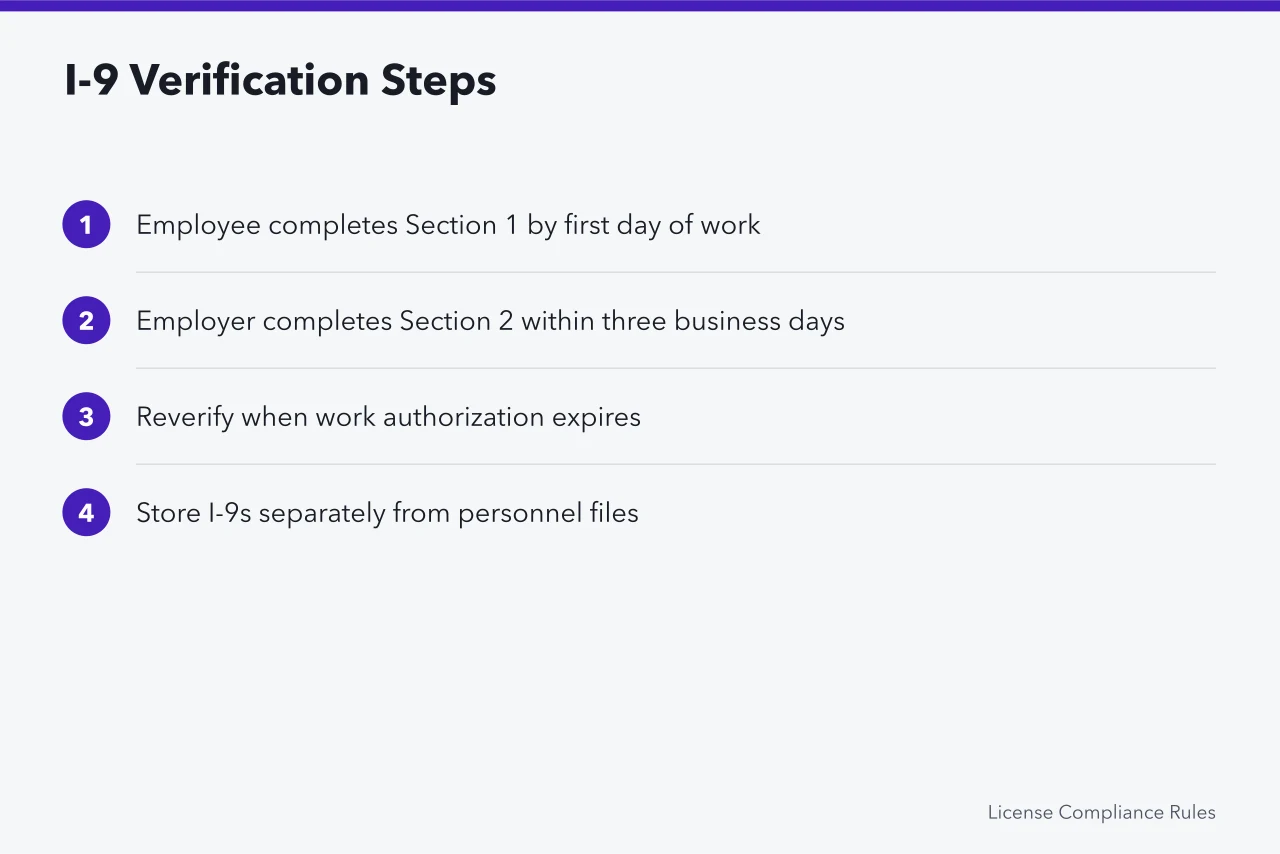
Form I-9 applies to every employee hired to work in the United States, including Canadian and Mexican nationals. The employee completes Section 1 by the first day of work. The employer completes Section 2 within three business days.
Remote verification is allowed in some cases, but the current rules govern. I-9 Central | USCIS carries the form, the lists of acceptable documents and the instructions.
Reverification is due when a work authorization expires, and an expired document cannot be accepted. A calendar that tracks expiry dates is the cheapest control against a lapse that carries penalties.
Store I-9s separately from personnel files and keep them for the required period. A missing or incomplete form is a common audit finding.
Visa categories run on their own track. A Canadian or Mexican professional entering under the agreement may use a TN visa; an intra-company transfer may use an L-1. Canada and Mexico each have their own work permit rules for US employees sent the other way. These are immigration filings, not tax filings, and they need a separate owner.
Building the calendar from an inventory
A three-country calendar needs one owner and three clocks. The owner is usually a payroll or finance lead with support from HR and counsel. The clocks are the IRS, the CRA and the SAT, each with registration, deposit, return and information slip dates.
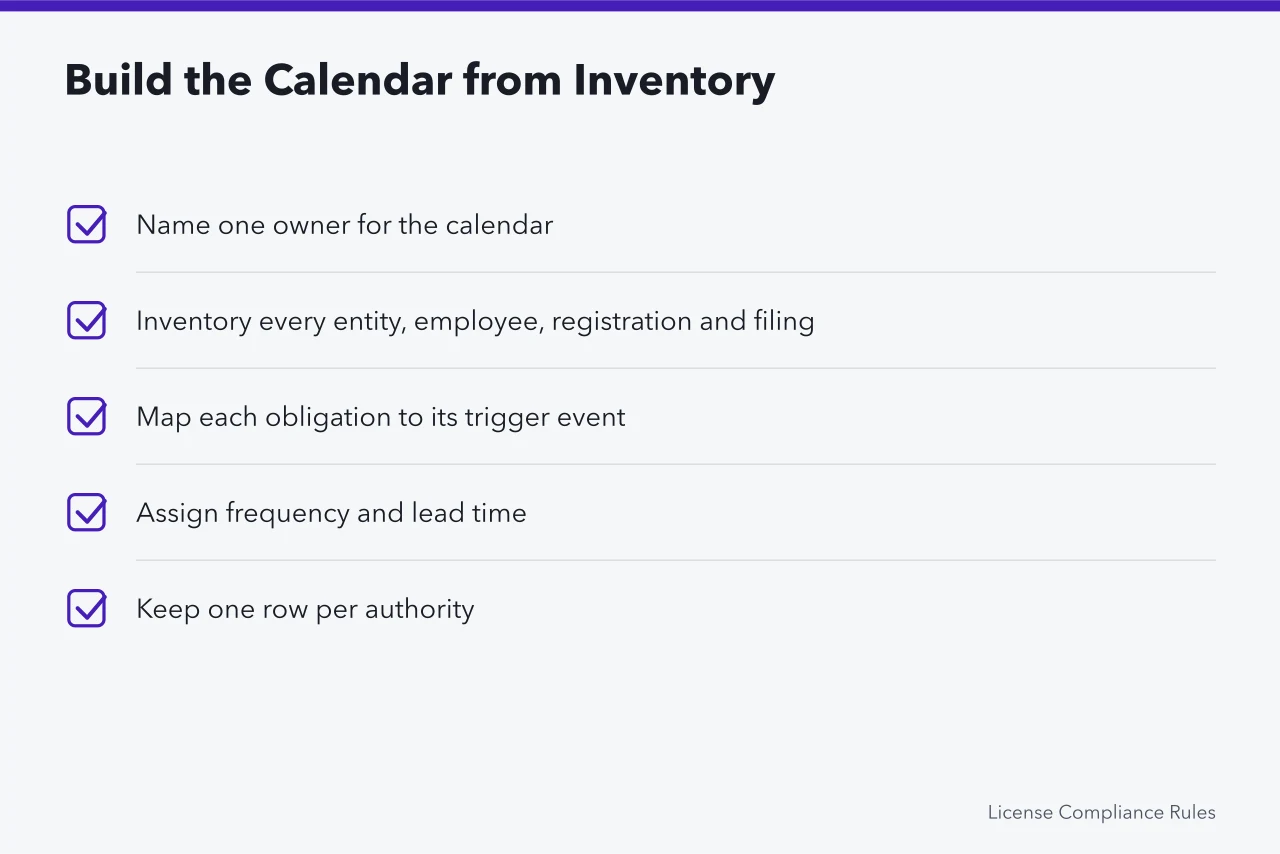
Start with an inventory, not a date list. starts with an inventory of every entity, employee, registration and filing. The inventory tells you which clocks apply before you try to schedule them.
Map each obligation to a trigger. A new hire in Ontario triggers a CRA payroll account. A new hire in Texas triggers a state new-hire report and federal forms. The trigger is the event; the date is the consequence.
Assign a frequency and a lead time. Monthly deposits need a reminder days ahead. Annual returns need weeks, because they collect data from several sources.
Keep the calendar as a table with a column each for country, authority, obligation, trigger, frequency and due date. Group similar items, but never merge two authorities into one row.
| Country | Authority | Obligation | Trigger | Frequency | Due date |
|---|---|---|---|---|---|
| United States | IRS | Form 941 | US payroll | Quarterly | Last day of month after quarter |
| United States | IRS | Federal deposits | US payroll | Monthly or semiweekly | 15th, or midweek schedule |
| United States | SSA | W-2 and W-3 | US payroll | Annual | End of January |
| Canada | CRA | Source deductions | Canadian pay | Monthly | 15th of following month |
| Canada | CRA | T4 and T4 Summary | Canadian pay | Annual | End of February |
| Mexico | SAT | Provisional payment | Mexican pay | Monthly | 17th of following month |
| Mexico | SAT | Annual return | Mexican pay | Annual | March |
| Mexico | IMSS | Social security | Mexican pay | Monthly | Following month |
Review the table every quarter. The home bakery license in florida rules show how fast a calendar goes stale when rates, thresholds or headcount move, and a new hire in a new province or state can add a filing outright.
Use a checklist for the first hire in each country. The order varies by entity and jurisdiction.
- Confirm the work location and the employee's tax residency.
- Register with the local authorityCRA payroll account or SAT RFC.
- Open any required state or provincial accounts.
- Set up withholding for income tax, social security and benefits.
- Complete Form I-9 for any US-based employee.
- Schedule deposits, returns and information slips.
- Store records for the required retention period.
Worked example: Seattle firm, two hires
A US software firm in Seattle hires one employee in Vancouver, British Columbia, and one in Guadalajara, Jalisco.
The Vancouver hire works from home, so the firm checks whether it needs a Vancouver for a Home Office business license under the city's rules, and registers a CRA payroll account before the first payday.
The Guadalajara hire triggers an SAT RFC, IMSS registration and a state payroll tax account in Jalisco. The Seattle payroll stays on the IRS deposit schedule, and the firm files Form 941 as it always did.
Three calendars now run where one ran before. A home business rules guide is useful here because the failure modes are the same ones home-based operators hit: a missed registration, a wrong deposit frequency, an expired work authorization. Each has a named owner and a quarterly review.
Document the calendar where the payroll team already works. A spreadsheet suits a small firm. A larger one may buy a compliance tool, but the tool is only as good as the inventory behind it, and the inventory is the part that needs a person.
Common questions
Do I need a Canadian payroll account if my only Canadian employee works from home?
Usually yes. Canada taxes income for work performed in Canada, so a resident employee working from home can create a CRA payroll account duty. The location of the work, not the office, is the test.
Are IRS filing dates different for foreign employees?
The employer's dates do not change. Form 941, Form 940 and the W-2 schedule apply to US-source wages whoever earns them. A tax treaty may change what the worker owes, not what the employer files.
What is the NAFTA successor rule for professional workers?
The USMCA keeps a temporary entry category for certain professionals from Canada and Mexico. A US employer can use it to bring a professional into the United States, subject to the visa rules in force at the time.
When is Form I-9 due for a cross-border hire?
The employee completes Section 1 by the first day of work, and the employer completes Section 2 within three business days. Reverification falls due when the work authorization expires, so track the expiry date.